A founding designer joins a company at six people. They're extraordinary. They produce entire product concepts in a week, throw half of them away without complaint, sketch three directions before lunch, and make decisions on instinct that turn out to be right often enough that nobody questions the instinct.
Three years later the company has sixty people, a real user base, and four designers. The founding designer is now a bottleneck. They resist documentation. They make decisions that contradict the design system. They ship things that are excellent in isolation and inconsistent with everything around them. Reviews with them have become tense, because the process that made them effective at six people is now generating rework for everyone else.
Nothing about them changed. The job did.
The inverse happens just as often. A startup hires a senior designer from a large, respected company — someone whose portfolio shows disciplined systems work and rigorous research. Six months in, they've produced a component library, a research plan, and a set of principles, and the product hasn't moved. They're waiting for data the company doesn't have and building infrastructure for a product that doesn't exist yet.
Also excellent. Also mismatched.
Two Genuinely Different Problems
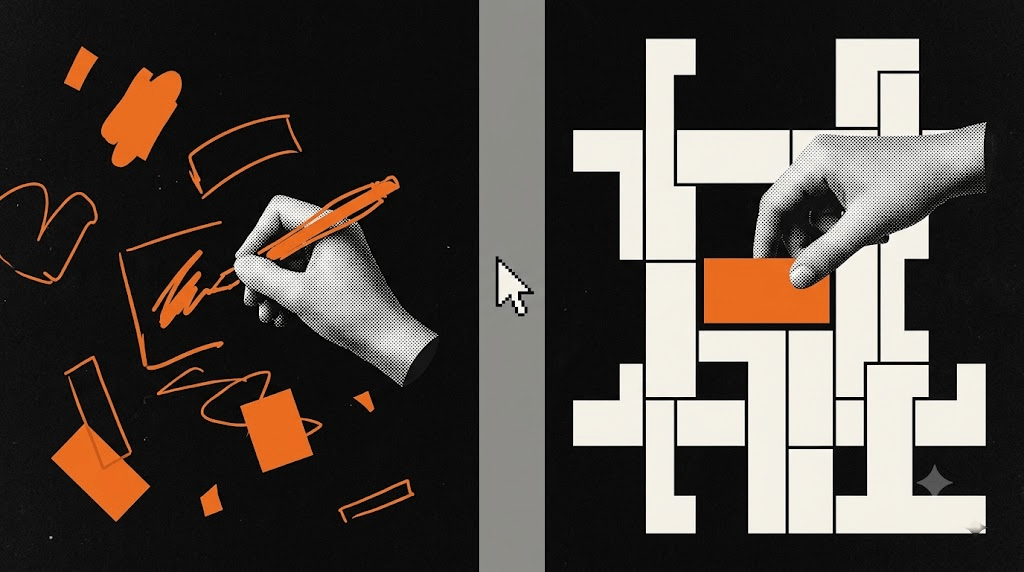
Zero-to-one and one-to-n look like the same discipline because they use the same tools. They're different problems with different constraints, and the working methods that suit one are actively counterproductive in the other.
Zero-to-one design operates without evidence. There are no users, so there is no usage data. There is no market feedback, because there's nothing to feed back on. The product's core proposition is a hypothesis. Design's job in this environment is to make the hypothesis concrete enough to test — to turn a vague idea into something specific that can be shown to people and either validated or killed. Speed is the primary virtue, because the value is in the number of hypotheses tested rather than the quality of any single artifact. Most of the output is disposable by design.
One-to-n design operates within a working system. There are users, and they have habits. There's data, and it constrains what can be claimed. There's an existing product with existing patterns, and any change has to coexist with everything already shipped. Design's job here is to improve something that works without breaking it — which means the primary risks are regression and inconsistency rather than irrelevance. Rigor is the primary virtue, because a wrong decision now propagates across a system and a user base rather than being thrown away in a week.
These are not points on a spectrum of seniority. A designer can be world-class at one and mediocre at the other, and the failure will look like incompetence rather than mismatch to anyone who doesn't understand that the jobs differ.
Where the Skills Actually Diverge
Decision-making under different evidence conditions. The zero-to-one designer must decide without data, repeatedly, and be comfortable doing so. Their judgment is the input, because nothing else is available. The one-to-n designer must decide with data, and — more importantly — must resist deciding without it when it's available. A designer trained to trust their instinct will overrule analytics that contradict them. A designer trained to demand evidence will freeze when there's none to demand.
Calibration of reversibility. Early decisions are cheap to reverse: nobody has learned the product, no documentation references it, no integrations depend on it. Later decisions are expensive: users have habits, docs exist, other teams have built on the pattern. The correct risk appetite is therefore very different. Moving fast and being wrong is nearly free at the beginning and costly later. A designer whose risk calibration was formed in one environment will systematically misjudge in the other — either being recklessly fast in a fragile system, or being cautious to the point of paralysis in an environment where caution has no payoff.
Breadth versus depth. Zero-to-one work covers the entire product shallowly. One person designs onboarding, the core flow, the settings, the marketing site, the pitch deck, and the empty states, none of them exhaustively. One-to-n work is narrow and deep: a single flow, examined thoroughly, with edge cases, states, error handling, accessibility, and instrumentation. Someone excellent at holding a whole product loosely in their head is not automatically good at holding one flow rigorously, and the reverse is at least as true.
The nature of the output. Zero-to-one output is artifacts for alignment and testing — prototypes to show people, concepts to argue about, mockups that exist to be reacted to. They don't need to be maintainable because they won't be maintained. One-to-n output is infrastructure: components, specifications, documentation, design tokens, patterns that other people will build on for years. A designer who produces beautiful throwaway work and a designer who produces durable systems are doing genuinely different crafts.
Coordination load. At zero-to-one there are two or three people and coordination happens by talking. At one-to-n there are stakeholders, adjacent teams, engineering constraints, existing commitments, and a review process. A large share of the one-to-n design job is communication and alignment, which is not what the job looked like at the beginning and which many people who loved the early phase actively dislike.
The Failure Modes in the Wrong Context
Put a zero-to-one designer in a scaling company and the symptoms are predictable. They ship work that's individually strong and collectively inconsistent, because they design from the problem rather than from the system. They resist documentation as bureaucracy, which is what it was at six people. They make decisions in conversation and don't record them, so nobody else can build on the reasoning. They find the review process suffocating and route around it. Their velocity, which was the team's greatest asset, becomes the source of everyone else's rework.
Put a one-to-n designer in a pre-product-market-fit startup and the symptoms are equally predictable. They ask for research the company can't fund and data that doesn't exist. They build systems before the thing the system would serve has been validated. They produce thorough work at a cadence that's too slow for a company that needs to test five ideas this quarter. They're uncomfortable making calls on instinct, which is the only way calls can be made when there's nothing to reason from. Their rigor, which would be an asset later, reads as an inability to ship.
In both cases the person is doing exactly what made them good, in an environment where it doesn't work. And in both cases the diagnosis inside the company is usually about the individual rather than the fit — which produces a lot of unnecessary departures and a lot of designers who conclude they've lost their edge when they've actually just changed problems.
The Transition Nobody Handles Well
The hardest version of this is a founding designer at a company that has outgrown the founding phase. It's a genuinely difficult situation with no clean answer, and it's usually handled badly in one of two directions.
The first bad handling is to keep them in place out of loyalty and let the mismatch compound. The system degrades because nobody owns it. Newer designers get frustrated because decisions are made in ways they can't participate in. The founding designer becomes increasingly defensive as their approach is questioned, and the resentment is mutual and understandable.
The second bad handling is to push them out — to hire a design leader over them and let them leave. This loses enormous institutional knowledge and treats a mismatch of phase as a failure of person, which is both unfair and inaccurate.
The third option is rarely considered and is often the right one: change the job rather than the person. Mature companies still do zero-to-one work — new products, new bets, expansions into adjacent markets, experiments that need to move fast and be thrown away. That work needs exactly the skills the founding designer has, and it's usually being done badly by people whose instincts were formed in the systems phase. Moving a founding designer onto new bets, rather than making them the steward of the existing system, uses what they're good at and gives the system to someone who wants to own it.
This requires the company to recognize that the two kinds of work coexist permanently rather than one replacing the other. Most companies don't, and treat the transition from zero-to-one to one-to-n as a phase change that everyone has to make.
How to Tell Which Phase You're Actually In
Headcount and funding stage are poor indicators. A forty-person company launching a new product line is doing zero-to-one work. A five-person company with a stable product and paying customers is doing one-to-n work. The useful signals are about the problem, not the company.
Is the core value proposition still changing? If what the product fundamentally does for whom is still moving, you're at zero-to-one, regardless of headcount. If it's settled and the work is about doing it better, you're at one-to-n.
Do you have enough usage data to decide with? Not "do you have analytics" — do you have enough traffic through the specific flow in question that the data means something? If decisions have to be made on judgment because the numbers are too thin to read, that's a zero-to-one condition even inside a large product.
Are you adding surfaces or deepening existing ones? New surfaces, new concepts, and new user types are zero-to-one work. Refining, systematizing, and hardening what exists is one-to-n work.
What is the main risk? If the main risk is "nobody wants this," you're at zero-to-one and speed of learning is what matters. If the main risk is "we break something that works," you're at one-to-n and rigor is what matters.
Answering these honestly, per project rather than per company, is more useful than any org-wide label. Most companies past a certain size are running both kinds of work simultaneously and would benefit from naming which is which — because the review standards, the expected velocity, and the definition of good output should all differ between them, and teams that apply one standard to both make one kind of work impossible.
The Same Distinction Applies to Hiring a Studio
This maps directly onto external design engagements, and it's worth being explicit about because the mismatch happens there too.
A studio engaged to help find a product — to explore directions, prototype quickly, test concepts, and produce artifacts that let a founder learn what they're building — is doing zero-to-one work. The right engagement is fast, iterative, and comfortable throwing work away. Judging it by the polish of individual deliverables misses the point; the deliverable is the learning.
A studio engaged to build a design system, harden an existing product, or bring consistency to something that grew organically is doing one-to-n work. The right engagement is rigorous, documented, and slower, and the deliverable is infrastructure that other people will build on for years. Judging it by how fast concepts appear misses the point equally.
Studios can do both, and the good ones are explicit about which one a given engagement is. The failures usually start with a mismatch in the brief — a client who wanted exploration hiring for systems, or a client who needed a durable system hiring a team optimized for velocity, and neither party naming the difference until the work is underway and the expectations turn out to be incompatible.
Naming the phase at the start of the engagement resolves most of it. It's a five-minute conversation that determines whether the next three months produce what the client actually needed.