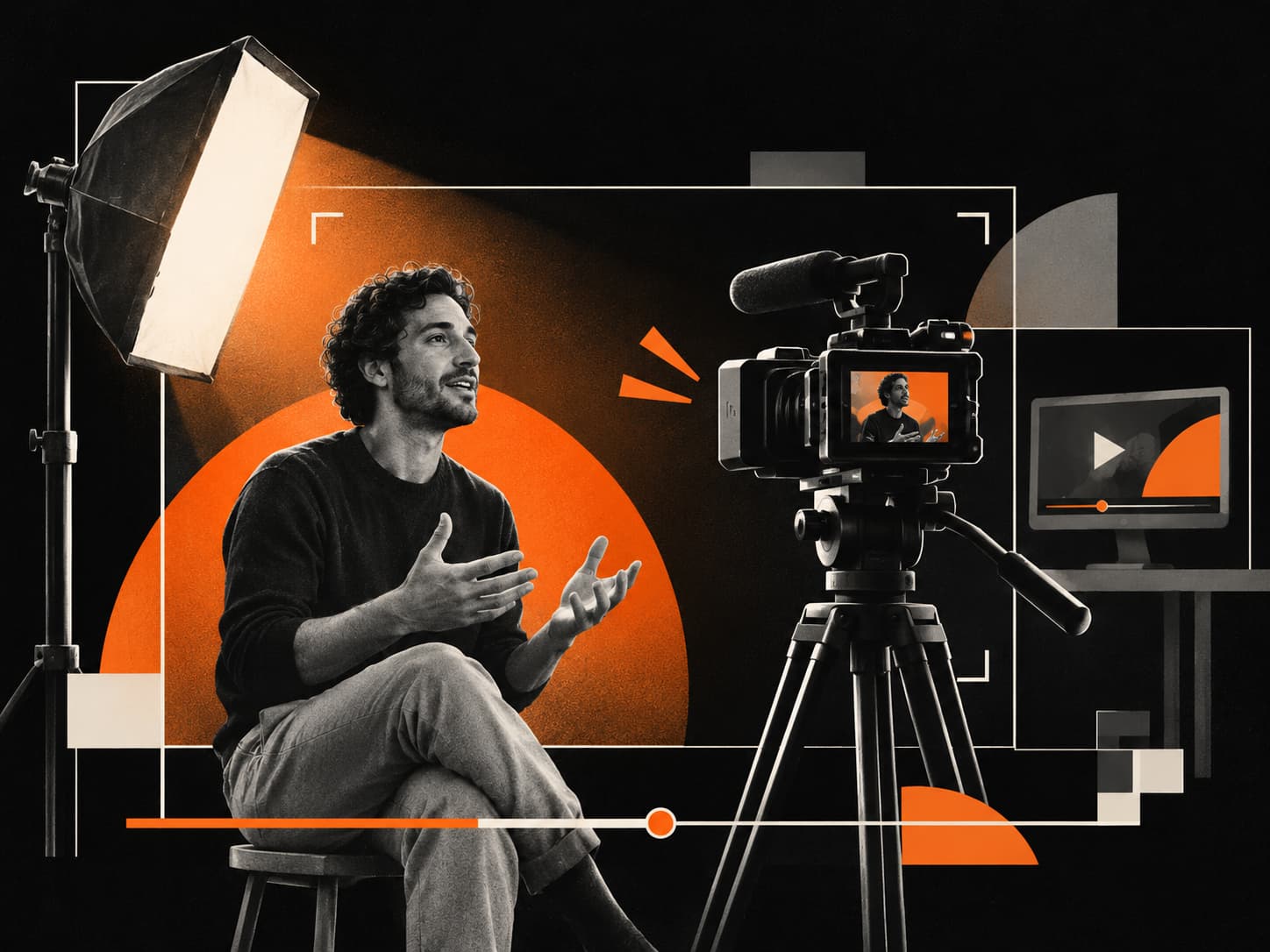
Short answer: it depends on the goal. For a feature launch, nobody needs to be on camera: you want it short, out fast, and showing the feature at its best. For your biggest launch, when you're facing customers, investors and people you want to hire, we recommend someone on camera. It doesn't have to be the founder, and nobody should be pushed into it.
Start with what the video has to say
Founders often ask us this as a style question. It isn't one. It comes down to what the video is about.
If it's about the company, the round, the vision, why you started, nobody tells that better than the founder. A real face and a real voice do something no animation can.
If it's about the product, what's new, how one action works, what changes in someone's day, animation shows that more clearly than anything else. That's why motion is our default for feature launches and product demos.
Before you pick a style, write down the one thing people should remember. The answer usually picks the format for you.
When someone on camera is the right call
- A funding round. Say the amount and who backed you, then spend the rest on why you raised. More in our funding announcement video guide.
- A new company or a big change in direction. People want to see who's behind it.
- Hiring. Candidates see who they'd work with and a team going somewhere.
Founder-led doesn't mean the founder talking to camera for 90 seconds. That isn't enough on its own. At some point motion comes in to show the product, or to carry a key line in type.
On camera you're not just looking into a lens. You're passing on the feeling, the vibe of your team and the vision you have in your head. That's what your biggest launch needs, and it's hard to get any other way.
When pure motion is the right call
For a feature launch, nobody needs to be on camera. You're trying to keep it short, get it out fast, and show the feature in the best way possible, and none of that depends on a face. Every frame is designed for your brand, and with no shoot to plan, it's also the faster route.
Our Stacks launch video is motion only, no filming. It's calm on purpose, and mostly carried by the voiceover. We still kept some human presence in it with photos, so it never feels like a product tour.
It's also where a hard-to-explain product often ends up. We wrote about that in the more technical your product, the less your launch video should explain it.
If the founder doesn't want to be filmed
We never push anyone on camera. Someone pushed in front of a lens won't give you the result you're after. There are other ways: the video can be motion-led, or someone else can be on camera, a co-founder or your head of business development.
Gumloop's $50M Series B video is a great example. The founder never appears on camera. The team is on camera at the start, which already gives you the close, human feeling. The voice is clearly the founder's, and he and his partner show up as sketches, so you never wonder who's speaking.
Stacks went a similar way: the script is written in first person, as the founder, read by a voice artist, and nobody speaks on camera.
A story told like that makes people want to be part of it, whether as a customer, an investor or someone joining the team. It's about how you handle it, not one strict rule.
If you mix them, keep coming back to the founder
A founder on camera with motion on top is a mix we make often. It only feels messy when the balance is wrong.
Show the founder for the first 10 seconds, then never again, and it feels like two videos stuck together. Keep coming back to them between the product moments, so they carry the story from start to finish.
- Change how close you are on the founder as the motion comes and goes.
- Place the graphics around them, never over their face.
- Keep AI footage and stock out. We don't put either into founder-led videos.
Plan the time differently
A filmed video needs more runway. Start 5 weeks before the launch, 6 if your team has to travel to film together. The work itself takes 2 to 3 weeks, the rest is fixing the date and getting everyone in one place. We shoot with our own crew in Europe, or with our partner crew in the US.
A motion-only video skips all of that and needs less time.
Filming does cost more than motion-only, but not as much as most people imagine. The difference is the one or two shoot days: a shoot is teamwork, with a director and camera people, where post-production is one team. And the story and the script still matter most. A boring script stays boring, however well you film it or animate it.
You don't have to pick one forever
On a recent project, the first idea was a founder-told story. As the script came together, it became much more about the product, which wasn't a bad thing. It was the right video for that launch.
What we suggested next was a few short founder-led videos after it. Not two minutes about everything, just quick updates. The launch video shows the product, and the founder keeps the story going.
Proof
Our Stacks launch video is motion only, no filming. It premiered at the Stacks Summit and has passed 700k views.
Not sure if your launch needs the founder on camera? Tell us the date and we'll tell you what we'd make.